The Paradox of Artificial Intelligence: A Human Creation
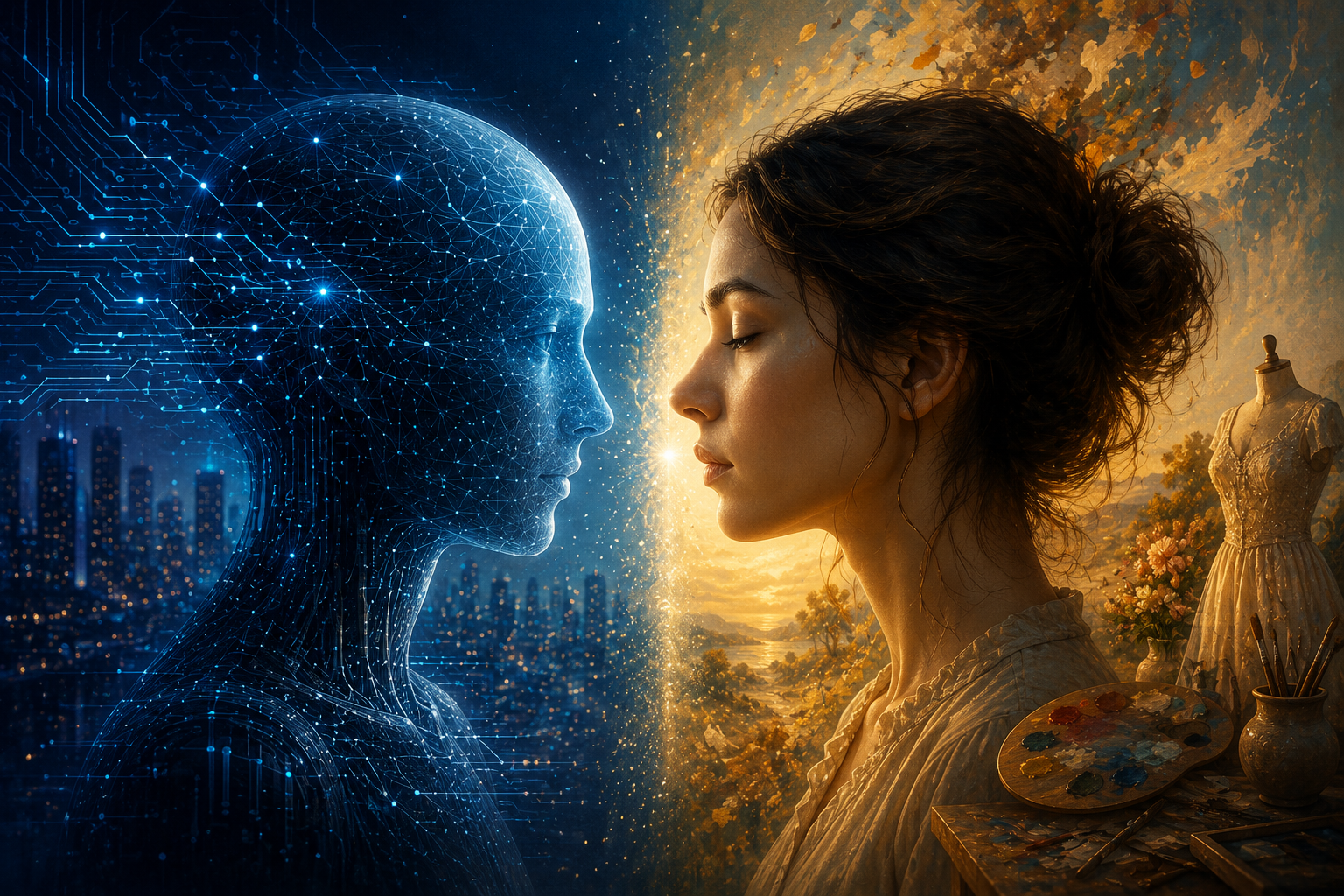
Artificial Intelligence is often spoken about as if it were an independent force reshaping society. Yet at its core, AI is nothing more than a sophisticated extension of human ingenuity.
► Humans designed the algorithms.
► Humans built the machines.
► Humans trained the models using human-generated data.
Every recommendation engine, language model, and automated system reflects the collective knowledge and decisions of the people who created it. AI does not invent from nothing; it learns from patterns embedded in human culture, language, and history.
This creates an interesting paradox: the more advanced AI becomes, the more it reveals the depth of human creativity that made it possible.
The Human Mind vs. Artificial Intelligence
At first glance, AI systems can appear almost magical. They write essays, generate images, compose music, and answer complex questions in seconds. However, the way AI operates is fundamentally different from how humans think and create.
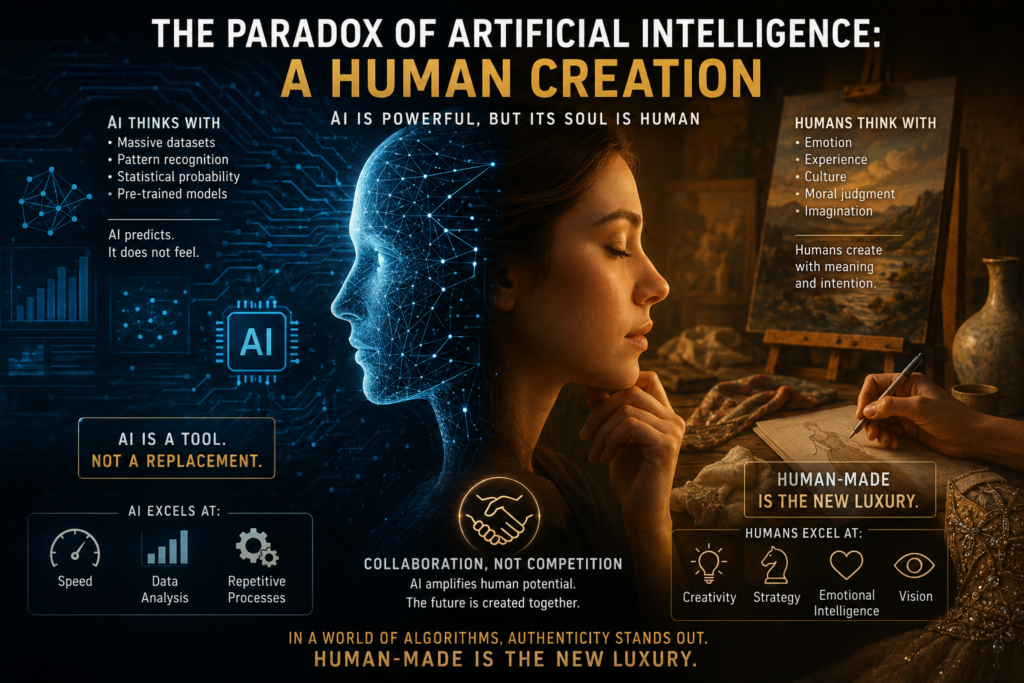
→ How AI Thinks
AI relies on:
- Massive datasets
- Pattern recognition
- Statistical probability
- Pre-trained models
It does not possess consciousness, feelings, or self-awareness. Instead, it predicts the most likely outcome based on past data.
→ How Humans Think
Human intelligence is shaped by:
- Emotion
- Personal experience
- Cultural context
- Moral judgment
- Imagination
A human writer does not simply predict the next word in a sentence, they choose it because of memory, meaning, and intention.
While AI can simulate creativity, human creativity originates from lived experience.
What AI Can and Cannot Do
Artificial Intelligence is an incredibly powerful tool, but its strengths and limitations are important to understand.
AI can process vast amounts of information quickly, identify patterns, and generate ideas based on existing data. This makes it extremely useful in fields such as design, marketing, branding, and business development. For example, AI can help designers create visual concepts, suggest color palettes, generate logo drafts, build website layouts, and analyze market trends to support strategic planning. It can also automate repetitive tasks, saving time and helping professionals explore multiple creative directions in minutes rather than days.
However, AI cannot replace human intuition, emotional intelligence, or original vision. It cannot understand cultural nuance the way a human strategist can, nor can it feel the emotional impact of a design, a brand story, or a business decision. While AI may propose design options or strategic ideas, humans are the ones who interpret meaning, refine the concept, and transform raw suggestions into something authentic and purposeful.
In this way, AI acts not as a replacement for creativity but as a creative assistant, a tool that expands possibilities while leaving the final vision in human hands.
Why Human Creativity Cannot Be Replaced
Artificial intelligence can imitate style, accelerate workflows, and assist with decision-making. But there are dimensions of human creativity that machines cannot reproduce.
→ Emotion and Empathy
Humans create from feelings: love, grief, curiosity, ambition. These emotional layers shape art, literature, and innovation in ways that data alone cannot replicate.
→ Meaning and Purpose
Humans create with intention. A designer, writer, or entrepreneur is not only solving a problem, they are expressing a vision.
→ Moral and Ethical Judgment
AI can analyze options, but humans decide what is right, responsible, or meaningful.
→ Imperfection
Ironically, what makes human creation valuable is its imperfection. The slight irregularities in handmade craftsmanship or the vulnerability in a personal story give human work authenticity.
Human-Made as the New Luxury
Historically, luxury meant rarity, objects that were difficult to produce and required exceptional skill. In the industrial era, machines made mass production possible. Now AI is creating a new wave of automation.
As automation increases, human effort becomes scarce again.
► A hand-written essay.
► A hand-crafted garment.
► A piece of art created without algorithms.
These will increasingly carry emotional and cultural value precisely because they were made by humans.
For example, in fashion, a couture dress entirely hand-stitched by artisans carries a different value than a digitally designed garment produced by automated manufacturing. Houses such as haute couture ateliers still rely on hours of human craftsmanship, embroidery sewn bead by bead, fabric draped by hand, skills that machines cannot fully replicate.
In art, collectors increasingly seek works that reflect the personal gesture of the artist: the brushstroke on a canvas, the imperfections of a ceramic sculpture, or the texture of handmade prints. Even as AI-generated images circulate widely online, a painting created through the artist’s lived experience holds a deeper emotional resonance.
In journalism and writing, a thoughtful editorial written by a journalist who has witnessed events firsthand carries a weight that automated summaries cannot match. Human storytelling brings context, moral reflection, and personal insight that go beyond simply organizing information.
In branding and business strategy, AI can analyze market data and suggest patterns, but the defining ideas of great brands still emerge from human imagination. A creative director shaping a brand narrative or a strategist interpreting cultural shifts brings intuition and vision that algorithms alone cannot provide.
In all of these fields, the human signature, the evidence of thought, intention, and craftsmanship, becomes a mark of authenticity. In a world increasingly shaped by automation, what is made by human hands and minds will stand out not only as rare, but as deeply meaningful.
Collaboration, Not Competition
The future is not a battle between humans and machines. The real opportunity lies in collaboration.
→ AI excels at:
- Speed
- Data analysis
- Repetitive processes
→ Humans excel at:
- Creativity
- Strategy
- Emotional intelligence
- Vision
When used wisely, AI becomes a powerful tool that frees humans to focus on higher levels of creativity and decision-making.
The goal is not to replace humans but to amplify human potential.
The Future: Technology with a Human Soul
As AI becomes more embedded in everyday life, society will face an important choice. We can allow automation to flatten creativity into predictable patterns or we can elevate the unique qualities that only humans possess.
The most valuable ideas of the future may not come from the fastest machine, but from the most thoughtful human mind.
In a world full of algorithms, authenticity will stand out.
And that is why human-made is the new luxury.
Editor’s Note
In a world increasingly shaped by algorithms and automation, it is easy to forget a simple truth: every machine, every line of code, every artificial intelligence system began as a human idea. AI may calculate faster and process more data than any human brain, but it cannot replicate the spark of human emotion, imagination, and lived experience. As technology grows more powerful, the human touch, the imperfect, intuitive, deeply emotional element of creation, becomes rarer and therefore more precious. This is why, in the age of AI, human-made is becoming the new luxury.

Stay Connected:
Follow us on Instagram: https://www.instagram.com/executivewomen_/
Connect on LinkedIn: https://www.linkedin.com/company/executive-women/
Like us on Facebook: https://www.facebook.com/ExecutiveWomen/
Read more articles: https://executive-women.global/afaaf-al-qorane-1st-qatari-female-boxer-breakthebias/