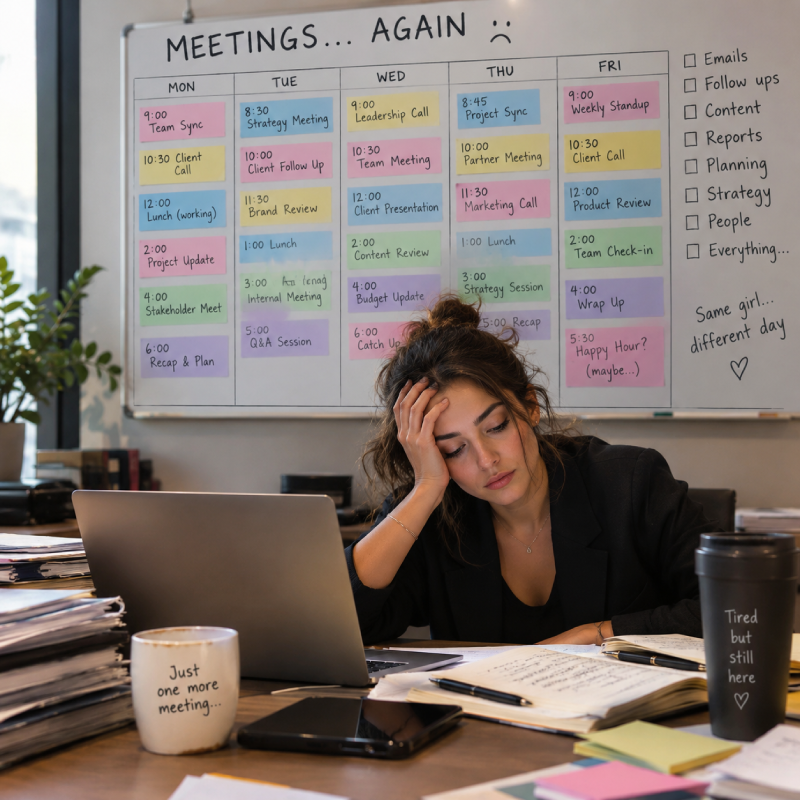
Welcome to the Burnout Bingo Card.
Missed lunch? Check.
Answered emails at midnight? Check.
Said “I’m fine” while mentally planning your escape to a cabin in the woods? Absolutely. Check.
It sounds funny. In reality, it describes a problem that millions of people experience without realizing how far they have pushed themselves.
Burnout rarely arrives with a dramatic announcement.
Instead, it collects small signs.
One late night.
One skipped meal.
One cancelled weekend.
One “I’ll rest after this deadline.”
Then another.
And another.
Eventually, your body starts keeping score.
Your First Square: “I’m Just Tired”
Everyone gets tired.
That makes burnout difficult to recognize.
You finish a busy week and feel exhausted. Naturally, you expect the weekend to fix everything.
But Sunday arrives.
You still feel drained.
Monday arrives.
You feel even worse.
That distinction matters.
Normal tiredness usually improves after proper rest. Burnout often does not.
Instead, exhaustion becomes your default setting.
You wake up tired.
You work tired.
You relax tired.
Eventually, you forget what genuine energy feels like.
First square: constantly exhausted. Check.
Square Two: Everything Suddenly Annoys You
Your colleague asks a simple question.
You want to scream.
Someone sends “Just following up.”
You immediately question your life choices.
Your computer freezes.
Suddenly, you consider throwing it out the window.
Burnout can shrink your emotional patience.
Psychologically, chronic stress keeps your nervous system on high alert. As a result, small problems can feel much bigger than they actually are.
You are not necessarily becoming a mean person.
You may simply have no emotional battery left.
And unfortunately, nobody can charge that battery with a motivational quote.
Square Three: The “I’ll Eat Later” Trap
Breakfast disappears.
Lunch becomes coffee.
Dinner becomes something you eat while answering emails.
Then you wonder why your body feels terrible.
Burnout often disrupts basic self-care because work starts consuming the attention that normally goes toward eating, sleeping, moving, and resting.
The dangerous part?
You may start treating this behavior as normal.
“I’m too busy.”
“I’ll eat after the meeting.”
“I’ll sleep earlier tonight.”
Sure.
And the moon will personally send you a calendar invitation.
Skipped meals and ignored basic needs? Check.
Square Four: You Cannot Remember Why You Opened the Laptop
Burnout does not only affect your emotions.
It can affect your concentration.
You read the same sentence three times.
You open an email and immediately forget what it said.
You walk into the kitchen and wonder why you went there.
You stare at a spreadsheet as if it contains ancient secrets.
Why?
Chronic stress can interfere with attention, memory, and mental flexibility.
Therefore, burnout can create an ugly cycle.
You struggle to concentrate.
Then you take longer to finish your work.
Then you work longer.
Then you become even more exhausted.
And suddenly, Tuesday feels like a personal attack.
The Psychological Square Nobody Talks About
Here comes the serious part.
Burnout can change how you see yourself.
At first, you might think:
“I have too much work.”
Later, the thought can become:
“I’m not good enough.”
That shift matters.
Instead of blaming an unhealthy workload, you blame yourself.
You begin questioning your abilities.
You compare yourself with colleagues.
You feel guilty when you rest.
You believe productive people should always have more energy.
Eventually, you may start measuring your worth by your output.
That mindset creates psychological pressure far beyond the workplace.
You are no longer simply doing a job.
You are trying to prove that you deserve your place.
And no amount of productivity can permanently satisfy that fear.
Square Five: Rest Makes You Feel Guilty
Here comes one of burnout’s strangest symptoms.
You finally get a free evening.
You sit down.
You try to relax.
Instead, your brain starts shouting:
“You should be doing something.”
So you check your email.
Then you check your messages.
Then you remember tomorrow’s meeting.
Suddenly, your “rest” becomes another work session.
That is not real recovery.
Your body may sit on the sofa while your mind remains at the office.
Psychologically, burnout can make rest feel unsafe because your brain associates stopping with falling behind.
Therefore, you need to relearn something surprisingly difficult:
Rest does not equal laziness.
Square Six: You Stop Caring
This one often scares people.
You used to care about your projects.
You had ideas.
You wanted to improve things.
Now?
You simply want the day to end.
That emotional distance can signal burnout.
Psychologists often describe this experience as emotional exhaustion and cynicism.
You stop expecting things to improve.
You stop getting excited.
You stop complaining.
You simply disconnect.
Ironically, that numbness can look like professionalism.
You still show up.
You still answer emails.
You still complete tasks.
But emotionally, you have already checked out.
Bingo: “I’m Fine”
Eventually, someone notices.
“Are you okay?”
You smile.
“I’m fine.”
That sentence deserves its own square.
Because sometimes “I’m fine” actually means:
“I cannot explain how tired I am.”
Or:
“I don’t know how to stop.”
Or even:
“If I stop, everything might fall apart.”
The problem becomes bigger when everyone accepts the answer.
So, ask again.
Not aggressively.
Not dramatically.
Simply ask:
“Are you really okay?”
Sometimes, that second question opens the door.
The Burnout Scorecard
You do not need to check every box to take burnout seriously.
Look for patterns.
Are you constantly exhausted?
Do you feel detached from your work?
Have you become unusually irritable?
Do you struggle to concentrate?
Do you feel guilty when you rest?
Have you stopped enjoying things you once enjoyed?
Do you regularly work beyond your limits?
Do you feel trapped in a cycle you cannot control?
If several answers sound familiar, pay attention.
Your body may be asking for something your calendar refuses to provide.
Your Boss Is Not Your Nervous System
Work matters.
Your career matters.
Your ambitions matter.
However, none of them should require you to sacrifice your entire identity.
A healthy workplace should not reward permanent exhaustion.
Likewise, employees need boundaries.
Turn off notifications when possible.
Take actual breaks.
Eat properly.
Protect your sleep.
Use your vacation days.
Talk to someone when stress becomes overwhelming.
Most importantly, stop celebrating exhaustion as proof of commitment.
Being constantly tired does not make you more dedicated.
It makes you tired.
Delete the Final Square
Perhaps the most dangerous belief on the burnout card says:
“I can push through.”
Sometimes you can.
But you should not have to push through everything.
Strength does not mean ignoring every warning sign.
Sometimes strength means stopping before your body forces you to stop.
Sometimes ambition means knowing when enough is enough.
And sometimes the most productive thing you can do is close the laptop.
No apology.
No guilt.
No dramatic farewell.
Just close it.
Because your career represents one part of your life.
It should never become the whole card.

Stay Connected with EWG:
Follow us on Instagram: https://www.instagram.com/executivewomen_/
Connect on LinkedIn: https://www.linkedin.com/company/executive-women/
Like us on Facebook: https://www.facebook.com/ExecutiveWomen/
Read more articles: https://executive-women.global/when-your-body-betrays-you-how-do-you-rebuild-yourself/
https://executive-women.global/women-in-hospitality-leadership-breaking-the-glass-ceiling/
https://executive-women.global/making-a-job-from-a-hobby-you-love-by-pamela-sakha/