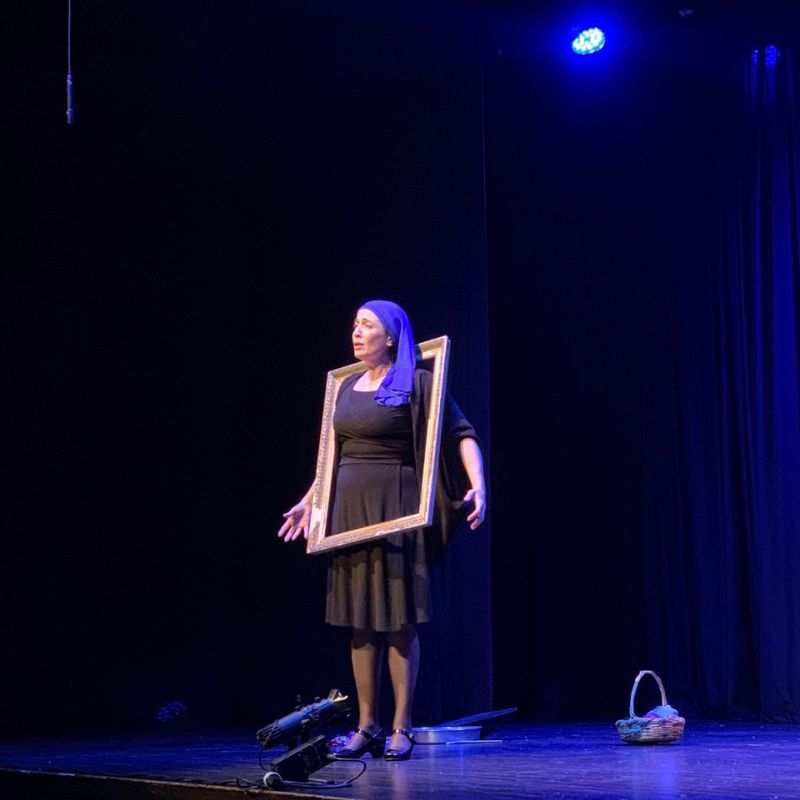
One stage becomes many lives. Maria Douaihy, through a single body and multiple voices, the play reflects a society in all its complexity, exploring identity, memory and belonging.
In “Qornet El Bayda”, directed by Yehia Jaber, the stage was stripped of excess, allowing the body of the actress to become the primary architecture of meaning. With no elaborate scenography to shield or distract, Maria stood alone, not as a solitary figure, but as a landscape of many lives. The minimalism was deliberate. It demanded attention not to spectacle, but to substance.
Yehia Aber’s direction trusted stillness. He allowed silence to speak. He permitted pauses to linger long enough for the audience to feel the weight of what is often left unsaid. This restraint amplified Maria’s transformation across characters. Each shift did not feel theatrical for its own sake, but necessary, as though each woman had been waiting her turn to be heard.
What was particularly striking was that the characters were neither idealized heroines nor simplified victims. They were complex, flawed, tender, humorous, and, at times, complicit in the very systems that constrain them. This nuance prevented the work from becoming didactic. Instead, it became dialogical, inviting reflection rather than prescribing judgment.

Q&A with Maria Douaihy: “The Body Who Carried Characters”
Maria Douaihy discusses the skill behind her performances.
1- You stood alone on stage and became 30 different lives between men & women. As a woman and a mother, what did it cost you to carry them all?
It was challenging.
First, mentally, because I had to incorporate the essence of each character and accept and understand its motives and structure.
Then, emotionally, because I had to carry each character’s specific range and quality of emotions.
And physically, because I had to find each character’s physical and vocal expressions.
And the most challenging was to shift as an actress swiftly from one to another while conveying the whole character to embody it.
It is an enormous pleasure to carry all these characters on stage and to bring them to life.
2- You grew up in the north, where this story lives. Did playing these women feel like honoring the women you have known?
Honoring them through unfolding their true stories, giving them a voice to speak loudly about what they think, what they feel and how they are molded. Honoring but criticizing them also because they are the guardians of the patriarchal system that rules their lives.
3- The article says your body tells entire life stories. How did you learn to speak so clearly without words?
The body carries the character and his story, and it shapes the voice. So vocal flexibility is somehow linked to the body’s flexibility and vice versa, and these are our tools as actors, and we work on them consistently in order to master them professionally.
4- You became many different people. Was there one woman who refused to leave you after the curtain fell?
They all stay with me, but Triza is the one I cherish the most because she transforms during her scene and the evolution of her story and somehow embodies a modern example of the woman. I love her naivety and her honesty and boldness.
5- After giving voice to so many others, what is left for Maria? What do you still want to say for yourself?
There is hopefully a next part of the play we will be working on later, and it is more related to modern times and issues that we relate to nowadays. I have so much to say and discover and also a lot of changes to make on a personal level and for the public.
Beyond One Name: Maria’s Performance and the Many Identities of Women
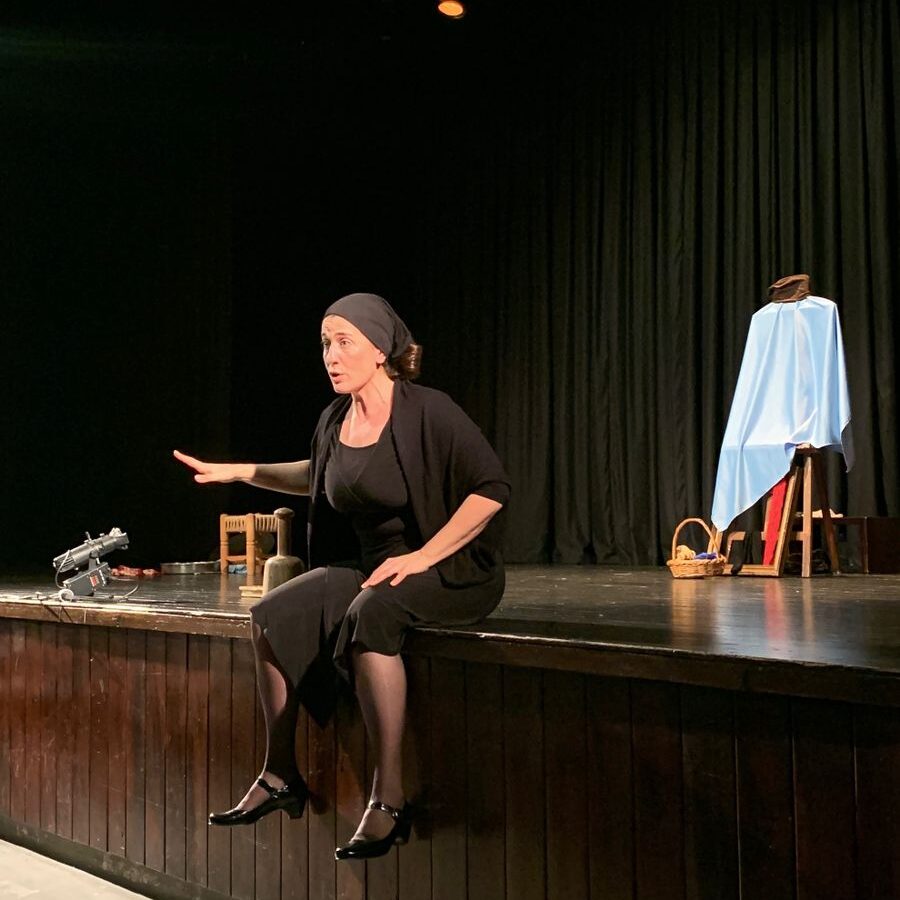
In her recent monologue, Maria did more than perform; she became a vessel of stories, a living archive of voices that have often gone unheard. Moving effortlessly across 30 characters, she embodied women and a few men, from different generations, backgrounds, and walks of life. With a tilt of the head, a pause in breath, or a shift in tone, each persona came alive, whole and vivid. Watching her was like watching memory itself take form on stage, delicate, precise, and profoundly human.
What made the performance especially moving was its quiet question, one that echoes across the Arab world: How is a woman named, and therefore known? For many, a woman’s identity is traced through her relationships: first as a daughter (Bint Kamal, daughter of Kamal), then a wife (Zoujit Georges, wife of Georges), and later, perhaps, a mother (Um Jad, mother of Jad). Her own name, her own self, is often buried beneath the roles she carries.
Maria’s performance illuminated the irony within this pattern. When a woman steps beyond these labels, society can struggle to recognize her essence. Yet it is her labor, her care, her presence, in every season of life, that sustains family, community, and culture. Through her performance, Maria reminded us that a woman is never only what she is called; she is all she holds, all she becomes, and all she gives.
Jaber’s direction emphasizes clarity and intention. The minimal set and the singular presence of Maria allow the audience to focus entirely on the human experience that he and Maria have brought to life.
What makes “Qornet El Bayda” remarkable is how Yehia Jaber captured the essence of northern Lebanese society through careful study and close collaboration with Maria, the daughter of that society…
And the result is this well-crafted text by Jaber, that feels both precise and alive, every line, pause, and gesture carefully designed to reflect the rhythms, tensions, and social textures of the region.
Through this careful construction, the play becomes not just a story but a vivid reflection of a society, rendered with subtlety, authenticity, and extraordinary attention to detail.
Women as Living Heritage: Carriers of Memory, Makers of Culture
Beyond identity and naming, Maria’s performance also evoked a deeper truth: women are not only part of heritage – they are often the ones who form it, embody it and transmit it across generations. From villages to cities, history is frequently preserved not in monuments, but in the lived rituals women sustain daily.
Her characters reflected how culture travels through the hands and voices of women: in the preparation of food, the shaping of traditions, the rhythm of communal life, and the quiet continuity of belief. Recipes such as ‘kibbeh neyeh’ are not merely culinary creations; they are inherited knowledge systems; measured by touch, memory and storytelling rather than written instruction. Through such practices, women become custodians of taste, time and belonging.
The same applies to the village bakery (forn), the gathering spaces where dough becomes bread and daily life becomes a shared narrative. Around these ovens, stories are exchanged, sayings are born and communal bonds are strengthened. Women’s presence in these spaces has long connected nourishment with social memory – blending labor with language and routine with ritual.
Maria’s embodiment of these layers brought forward another dimension: how women have historically carried faith, poetry, and oral tradition within the domestic and communal sphere. Lullabies, whispered prayers, proverbs and folk verses often pass from grandmother to mother to child, forming an invisible archive of collective identity. These expressions may seem intimate and personal, yet they shape the cultural consciousness of entire societies.
Seen through this play, Maria’s performance was not only theatrical storytelling, but a reflection of how women themselves become vessels of history – shaping culture not only through public achievement, but through the everyday acts that sustain community, memory and meaning.
Through her body language alone, she traced entire life stories; the hesitation of a young bride, the grounded rhythm of a working mother, the worn yet dignified stillness of an elder. Her voice carried history: at times lyrical and melodic like inherited poetry, at others intimate like whispered prayers and at moments sharp with truth. The script unfolded as a tapestry of traditions, memories, humor and devotion; Maria carried it with a rare emotional intelligence that made each element feel lived rather than recited.

The Power of Women’s Narrative Authority
In the spirit of Executive-Women Global, this performance also invites a broader reflection on leadership and identity. Women across the region – and the world – continue to navigate multiple roles simultaneously: professionals, caregivers, creators, community anchors, and custodians of heritage. Their influence often precedes formal recognition; their impact is systemic even when their titles are not. Maria’s monologue reminds us that representation is not only about occupying space, but about telling stories that reveal how deeply women already shape it.
Ultimately, Maria did not just perform characters; she restored names, histories and voices. Her work stands as a reminder that when women claim authorship of their own narratives – on stage, in institutions and in society – identity shifts from something assigned to something owned.
In the end, “Qornet El Bayda” reminds us that identity is not something to be granted; it is something to be claimed. Through Maria’s voice and Yehia Jaber’s careful design, the stage became a space where women were not defined by their roles, but by their presence. And in that presence, their stories stood, whole, complex, and undeniably their own.
Stay Connected:
Follow us on Instagram: https://www.instagram.com/executivewomen_/
Connect on LinkedIn: https://www.linkedin.com/company/executive-women/
Like us on Facebook: https://www.facebook.com/ExecutiveWomen/
Read more articles: https://executive-women.global/loreal-paris-lebanese-women-at-its-2025/