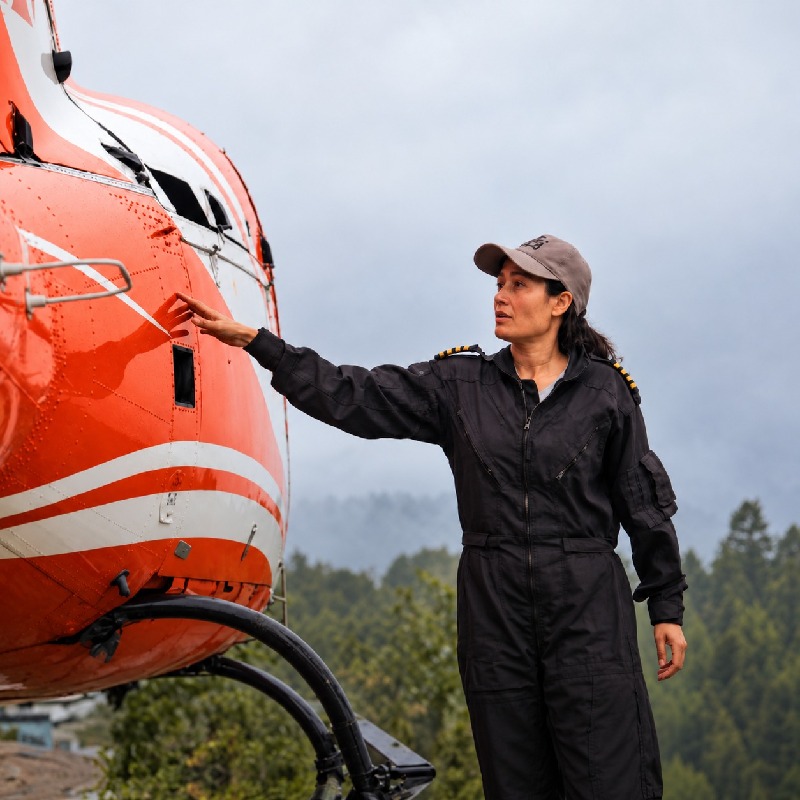
An Exclusive Interview with Captain Priya Adhikari, Nepalese Helicopter Rescue Pilot
Some people dream of touching the sky. Others find their purpose in the lives they bring safely back to earth.
Courage is often mistaken for the absence of fear. Yet perhaps its truest expression lies in facing uncertainty, accepting responsibility, and moving forward when someone else’s life depends on it.
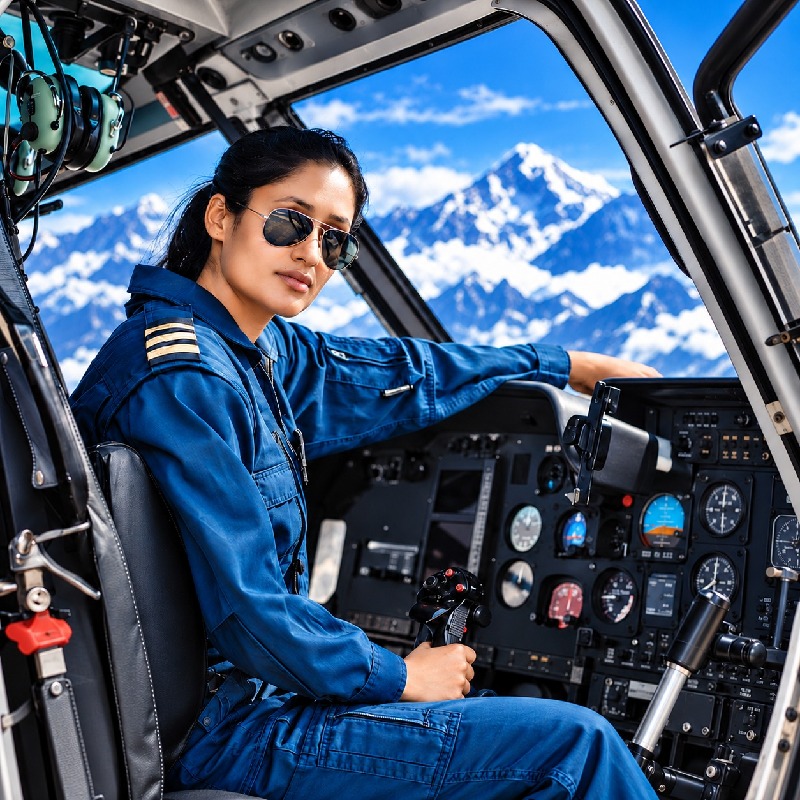
Captain Priya Adhikari, Nepal’s pioneering helicopter rescue pilot, embodies a kind of courage that goes beyond breaking barriers. Her journey is not simply about flying helicopters or reaching extraordinary heights, but about the humanity behind every mission.
In this exclusive conversation with our CEO, Jad Kamel, Captain Priya Adhikari shares her remarkable journey of courage, resilience, and purpose, reminding us that true leadership is not measured by how high we rise, but by the lives we touch along the way.
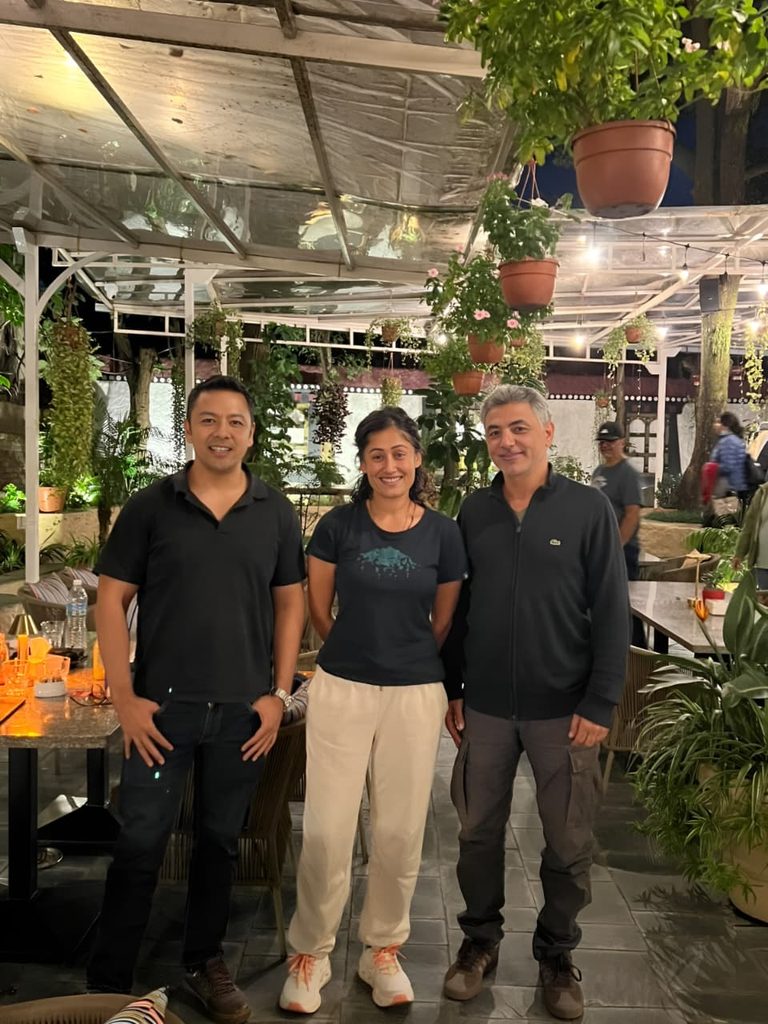
Because sometimes, the greatest heights we reach have nothing to do with the sky.
Q: You have spent more than fifteen years in a profession where women remain rare. What does being Nepal’s only active female helicopter pilot mean to you, and why do you think more women have not entered this field?
Priya Adhikari: It honestly doesn’t make me feel anything different. There are male pilots, and there are other pilots. I am simply one of them.
But when you ask why there aren’t more women, I think culture has something to do with it.
In some Nepalese families, daughters are still expected to marry and eventually become part of another household. So perhaps families hesitate to invest so much in their professional training.
And helicopter flying is expensive. When I trained, it cost around $50,000. Today, training can cost around $100,000, and with living expenses, it can reach $120,000 to $130,000.
There are many female fixed-wing pilots in Nepal, but helicopter flying is a very different lifestyle.
You don’t have a fixed schedule. You don’t know where you will sleep tomorrow. You might be in Kathmandu today and somewhere in the Himalayas tomorrow, with no proper accommodation.
It is a tough profession, and I think that discourages some women from pursuing it.
Q: Beyond the technical challenges of flying, what has been the most difficult part of establishing yourself in a male-dominated profession?
Priya Adhikari: When I started helicopter flying, I was alone among the male helicopter pilots in Nepal.
It was their world, and I was someone different trying to enter it.
They didn’t always accept me. Some wouldn’t talk to me. Others were very mean. Whenever I tried to speak up, they would tell me I was too loud.
In those early years, around 2010, 2011, and 2012, I used to go home and cry.
I would cry all night and then return to work the next morning with a smile.
At the time, I didn’t really understand what I was going through. Looking back, I think I might have been experiencing depression, but I didn’t know much about it then.
Growing up with sisters and no brothers, I wasn’t prepared for that kind of treatment.
But I kept going.
And today, those same people are my friends. I’m their sister, and I’m part of their world.
I think those experiences made me stronger.
Q: Your work takes you into remote mountain regions, often without a predictable schedule or even basic facilities. What does an ordinary working day look like for you?
Priya Adhikari: There is no ordinary day!
Tomorrow morning, I might be going to Lukla. Then I might fly from east to west, north to south, or wherever I am needed.
Recently, I spent five nights in Chame, Manang, doing base camp flights. I’ve also been in Samagaon for Himalayan expeditions, carrying equipment and conducting rescue missions.
Sometimes I don’t even know where I will spend the night. There may be no proper bed, and I might have to sleep on a table.
And do you know what one of my biggest practical challenges is?
Finding a toilet!
Sometimes someone tells me the nearest toilet is ten minutes away, and I simply don’t have that much time between flights. I have to find a solution right there.
That’s one of the few things that makes being a woman in this profession more complicated for me.
Otherwise, I just get on with the job.
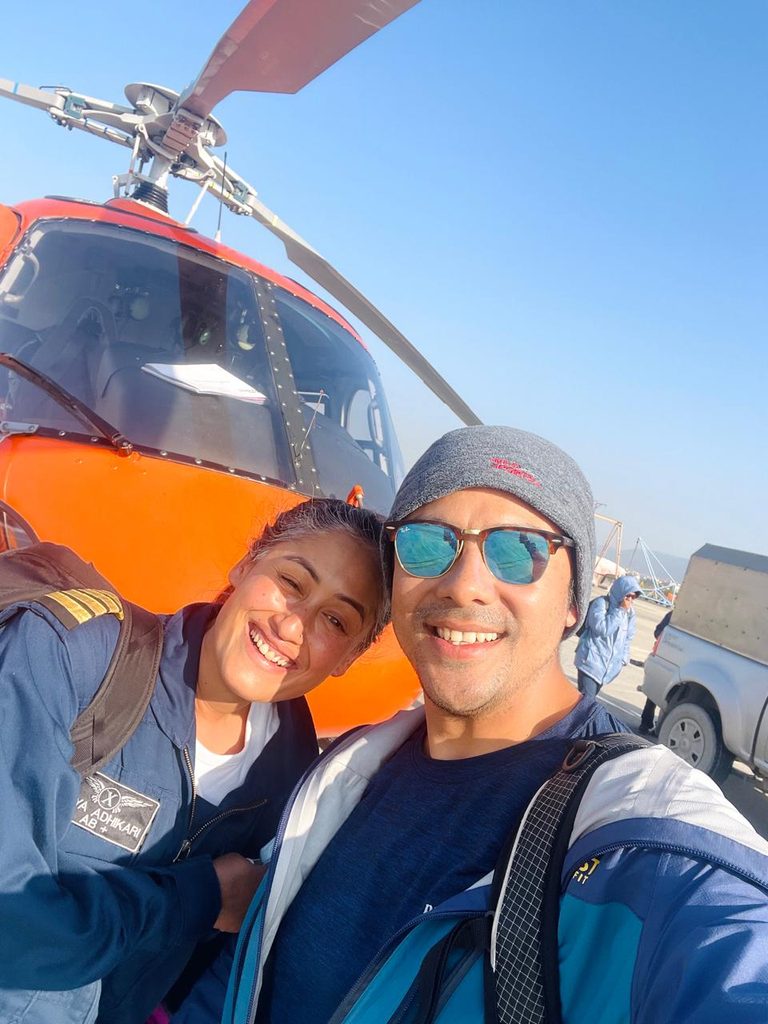
Q: With such an unpredictable and demanding career, how have you managed to build a personal life that allows you to remain committed to flying?
Priya Adhikari: I’m very fortunate to have understanding parents and a very understanding husband, who is also a helicopter pilot.
My husband and I have made our own choices about how we want to live. We have decided not to have children, and that is a decision we made together.
We want to be able to focus on our work and live with a free mind.
My parents have also been incredibly supportive. They take care of themselves, and my sister checks on them, so I can travel and work without constantly worrying about home.
When I’m flying in remote areas without a mobile network, I carry a Garmin satellite communicator so I can contact my family, friends, or office if necessary.
That support system makes a tremendous difference.
I can do the work I love because the people closest to me understand and respect my choices.
Q: High-altitude rescue operations demand extraordinary precision. How do you make decisions when someone’s life depends on you, particularly under dangerous weather conditions?
Priya Adhikari: You cannot allow yourself to become emotionally attached during a rescue.
If you do, you start putting pressure on yourself to complete the mission, even when the conditions are dangerous.
And that can affect your judgment.
We’re talking about rescues at 5,000, 6,000, or even 7,000 meters. You are risking your life, the safety of your helicopter, and sometimes the life of your passenger.
You have to make very careful decisions.
For example, I recently rescued someone from the Manaslu region. I was in Samagaon, and the person needed to be picked up from approximately 20,000 to 21,000 feet.
The weather was challenging, and the mountains were covered in clouds.
The people there told me that if I didn’t reach him that day, he might not survive.
I managed to get him down.
Later, on my day off, I went to visit him. He had spent nine days in intensive care and told me he couldn’t remember anything about the rescue.
That’s how I connect with people.
During the mission, I have to concentrate completely on my work. But afterward, when I can, I meet the people I’ve rescued.
Q: You have witnessed both survival and devastating loss. How do you protect yourself emotionally while continuing to show compassion to the people you rescue?
Priya Adhikari: I’m trained for these situations.
I’ve recovered bodies from mountain expeditions and disaster areas. It’s difficult work, but I remind myself that I’m helping families bring their loved ones home.
Sometimes that’s the only thing I can do for them.
My mother is very emotional about these missions. When I come home, she performs little rituals because she worries about what I might be carrying with me emotionally.
But I tell her, “Mom, I’m not carrying anything in my heart or my head. I’m just doing my work.”
Of course, there are moments when things affect me.
During the floods in Rasuwa, I flew over areas I knew very well, and so much had disappeared. Buildings, infrastructure, places I had seen almost every day were simply gone.
I cried during that first flight.
But the next day, I told myself that I had to put those feelings aside and concentrate on helping people.
I couldn’t change what had already been destroyed.
What I could do was rescue the survivors.
When someone came into my helicopter injured and frightened, I would smile and tell them, “Hey, you survived. Calm down. I’m going to take you to the hospital. You’re going to be okay.”
That’s what mattered to me.
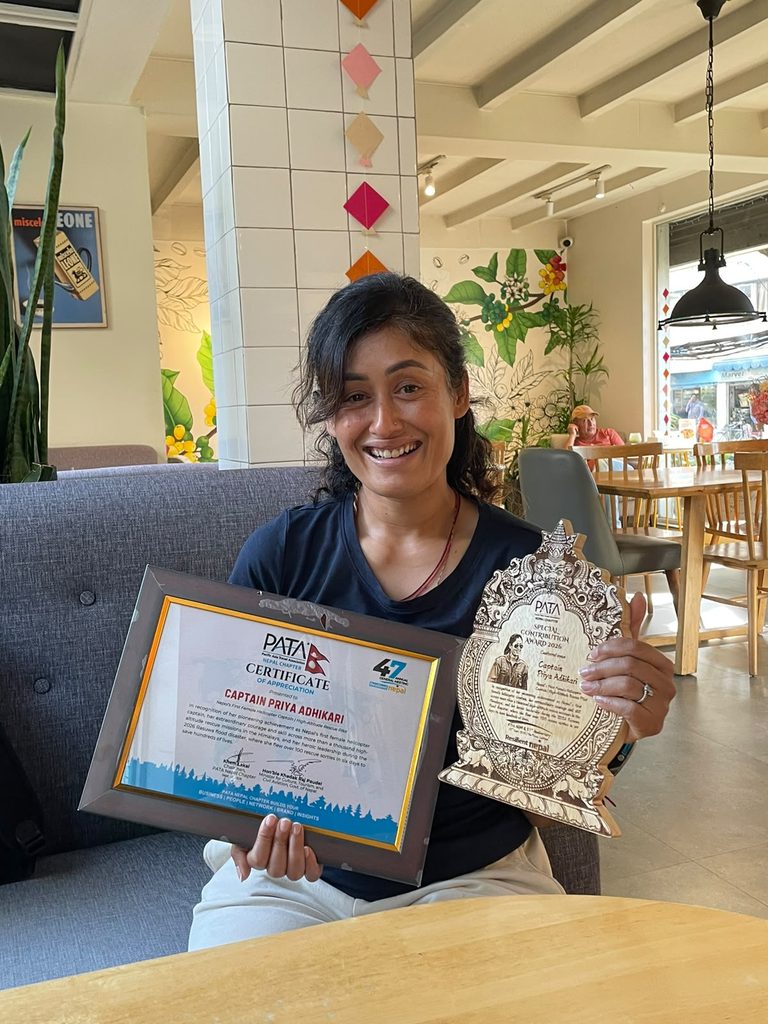
Q: You also survived a helicopter crash during an expedition near Dhaulagiri Base Camp. How did that experience change you as a pilot?
Priya Adhikari: I was flying near Dhaulagiri Base Camp, and I knew the wind was strong.
I had diverted, but when I checked the cockpit information, the wind appeared to have decreased. So I decided to turn around and try again.
Then I encountered strong downdrafts near the mountain.
The helicopter started losing altitude, and I knew I was going down.
I had a passenger with me, and I was trying to find somewhere to land.
Eventually, I saw a possible landing spot and managed to bring the helicopter down, but it was a crash.
I got out and started crying.
I wasn’t physically hurt. What upset me most was seeing the helicopter damaged.
And I kept asking myself, “Why did I turn around? Why did I make that decision?”
For months, I thought about it.
But I went back to flying.
That experience changed my operating procedures. Now, if conditions aren’t right, I don’t keep trying repeatedly.
I turn back.
For me, safety comes first, and that experience taught me an important lesson about decision-making.
Q: Your rescue missions have taken you to extraordinary altitudes. Is there a particular achievement or mission that stands out in your career?
Priya Adhikari: I’ve already achieved more than I ever imagined.
I never expected to become a helicopter captain or to reach the heights I’ve reached in rescue flying.
I’ve landed at approximately 6,700 meters during rescue operations, which is something I’m very proud of.
But there are also so many individual missions that stay with me.
I remember a Spanish climber who had been stranded at around 5,800 meters for six or seven days.
Initially, I was supposed to deliver food because there was no obvious place to land.
They told me that if I could land safely, I should try to bring him out. Otherwise, I should just drop the food.
I had someone assisting me in the helicopter, and we had to work out how to get the climber inside in those conditions.
I managed to land and bring him to safety.
Later, I received a letter from the Spanish Embassy.
There have been so many missions like that throughout my career.
Some are successful rescues. Others involve recovering people who didn’t survive.
Every mission is different, and every one requires careful judgment.
Q: You have spoken about recovering climbers who lost their lives and helping families bring them home. What gives you the determination to continue doing this difficult work?
Priya Adhikari: I think about the families.
During one expedition, we had to recover bodies that had remained on the mountain for months.
The conditions were difficult, and some of my colleagues were struggling with the situation.
But I kept telling them, “Just let me do my work.”
For me, it wasn’t about how unpleasant the conditions were.
Families had traveled from places like Canada, Italy, and Germany. They had been waiting for months to see their loved ones again.
I wanted to bring them home.
Even if you cannot save someone’s life, you can still do something meaningful for the people waiting for them.
That is how I look at my work.
Q: Your recent rescue missions have brought you considerable public attention. How do you feel about becoming a recognizable figure and an inspiration to others?
Priya Adhikari: I’m not someone who has ever tried to become famous.
For a long time, I wasn’t even on social media.
One of my younger clients kept telling me, “Didi, you’re doing such amazing work, and you don’t even have Instagram. You should show people what you’re doing!”
Eventually, I opened an account.
But I still didn’t share very much.
Then, during the flood rescue operations, people started filming me.
At first, I was actually angry.
When I landed at hospitals with injured people or bodies, I didn’t want cameras in my face.
I would tell people, “Get out of my face. I’m doing real work here. People are suffering.”
But someone filmed my rescue flights and posted a video showing how frequently I was flying in and out.
The video spread, and suddenly people began recognizing me everywhere.
Now people want to take pictures with me when I walk down the street.
It’s a good thing and a bad thing at the same time!
I also gave an interview to Anderson Cooper, whom I really admire.
But becoming famous was never my goal.
I’m just doing my work.
Q: Beyond flying, you have quietly supported people and communities facing difficult circumstances. What motivates you to help, even after a rescue mission is over?
Priya Adhikari: I love meeting people, talking to them, and helping them however I can.
Sometimes I meet people I’ve rescued afterward. I want to know how they’re doing and whether they need further support.
There is a young man I rescued from Camp 3 on Annapurna. He was only twenty-five, and he suffered serious injuries to his hands because of the cold.
He hasn’t been able to work, and I know he needs financial help.
I haven’t yet been able to meet him again, but I want to help him.
I also have someone I’ve considered a brother for thirteen years. He lives in a remote community that was affected by the floods.
He has two children, and because the roads were damaged, he couldn’t get basic supplies like rice and sugar.
I started organizing a GoFundMe campaign to raise around $4,000 so I could charter a helicopter, deliver essential supplies, and help bring his children to a place where they could attend school.
These are things I do because I know the people and understand their circumstances.
I don’t think of it as something extraordinary.
If I can help someone, I try.
Q: Throughout this conversation, one thing becomes clear: your work is about much more than flying helicopters. Have you always seen helping people as your purpose?
Priya Adhikari: I never really thought about it that way.
I just love going to different places, meeting new people, talking with them, and helping them however I can.
Sometimes people ask me to help everyone, but I cannot help everyone.
That’s something we also have to understand.
What I can do is help the people I’m able to reach, encourage others to help, and spread the word.
Maybe those people will then help someone else.
I didn’t realize that my voice could be so powerful.
I had no idea that people might listen to me and contribute money to help someone they had never met.
So maybe I need to think differently about that.
But for now, I just want to continue doing what I do.
Q: With so much already accomplished, what comes next for Captain Priya Adhikari? Are there still dreams you want to pursue?
Priya Adhikari: I think I’ve achieved so much already.
Sometimes my mother asks me, “You’ve done everything you wanted. What more do you want now? Why don’t you just go and live with your husband in Austria?”
So maybe my next step will be to obtain my EASA license and fly in the Alps.
I’ve already received job offers in Austria and other parts of Europe, but I need the license, and I haven’t had time to complete that process.
I’m rarely in Kathmandu. I’m always traveling and working.
People also keep telling me to document my experiences or write a book.
I used to write, but I stopped. Someone has even approached me about writing my story.
Maybe one day I’ll feel ready to share everything I’ve experienced.
And perhaps, one day, I’ll even have my own helicopter and be able to organize rescue missions independently.
I would love that.
But for now, I’m happy doing what I do.
I’m able to fly, help people, travel, and live my life in a way that works for me.
I’m grateful to my parents, my husband, my sister, and everyone who supports me.
Without that understanding, I couldn’t do what I do.
My life is hectic. I’m constantly moving from one place to another.
But I love it.
And I just keep going.

Stay Connected:
Follow for more: https://www.instagram.com/executivewomen_
Like us: https://www.facebook.com/ExecutiveWomen
Connect & Follow: https://www.linkedin.com/in/neo-porscha-makgale-29079957/
Read more articles: https://executive-women.global/lifting-women-higher-through-aviation-drone-training-by-neo-porscha-makgale/