
By Margueritta Rahal
Throughout history, the greatest minds, philosophers, physicists, and poets have quietly echoed a profound truth in their own unique words:
Life isn’t what it appears to be. And maybe, just maybe, it was never meant to be taken seriously.
Albert Einstein called reality “an illusion, albeit a very persistent one”, highlighting how our perception may not be the full truth.
Alan Watts invited us to shift perspectives, suggesting that life is not a problem to be solved, but a mystery to be enjoyed.
Even Socrates, the father of Western philosophy, humbly confessed, “All I know is that I know nothing.”
And yet here we are, rushing through routines, overwhelmed by roles, and obsessing over outcomes, as if we’ve cracked the cosmic code.
But what if we haven’t?
What if life is lighter, softer, more absurd, and playful than our anxious minds allow us to see? What if the stress, the pressure, the overthinking are just side effects of forgetting how strange and beautiful it all really is?
Pause for a moment and consider this:
We’re spinning at roughly 1,000 miles per hour on a floating rock in infinite space, surrounded by galaxies we can’t comprehend, orbiting a sun big enough to swallow a million Earths, surrounded by stars we can’t reach, in a body we didn’t design, breathing air we can’t see, driven by loud repetitive thoughts. We don’t remember where we came from before we were born. We don’t know where we go after we die. We close our eyes each night and we surrender to sleep, slipping into a world of dreams with no logic, without knowing how or why, and we call that normal, only to wake up and act like we’ve figured it all out and we unraveled the secrets of existence.
The truth?
We haven’t.
We just normalized the bizarre.
Life is wild. Strange. Chaotic. Tender. Beautifully absurd. A comedy, a tragedy, a miracle, all at once. A cosmic joke in which every participant is playing their part without a script. And the funny part is that no one will get out of it alive.
The more seriously we take it, the more disconnected we become from its mystery, and in this detachment, we overlook a powerful force that lies within us:
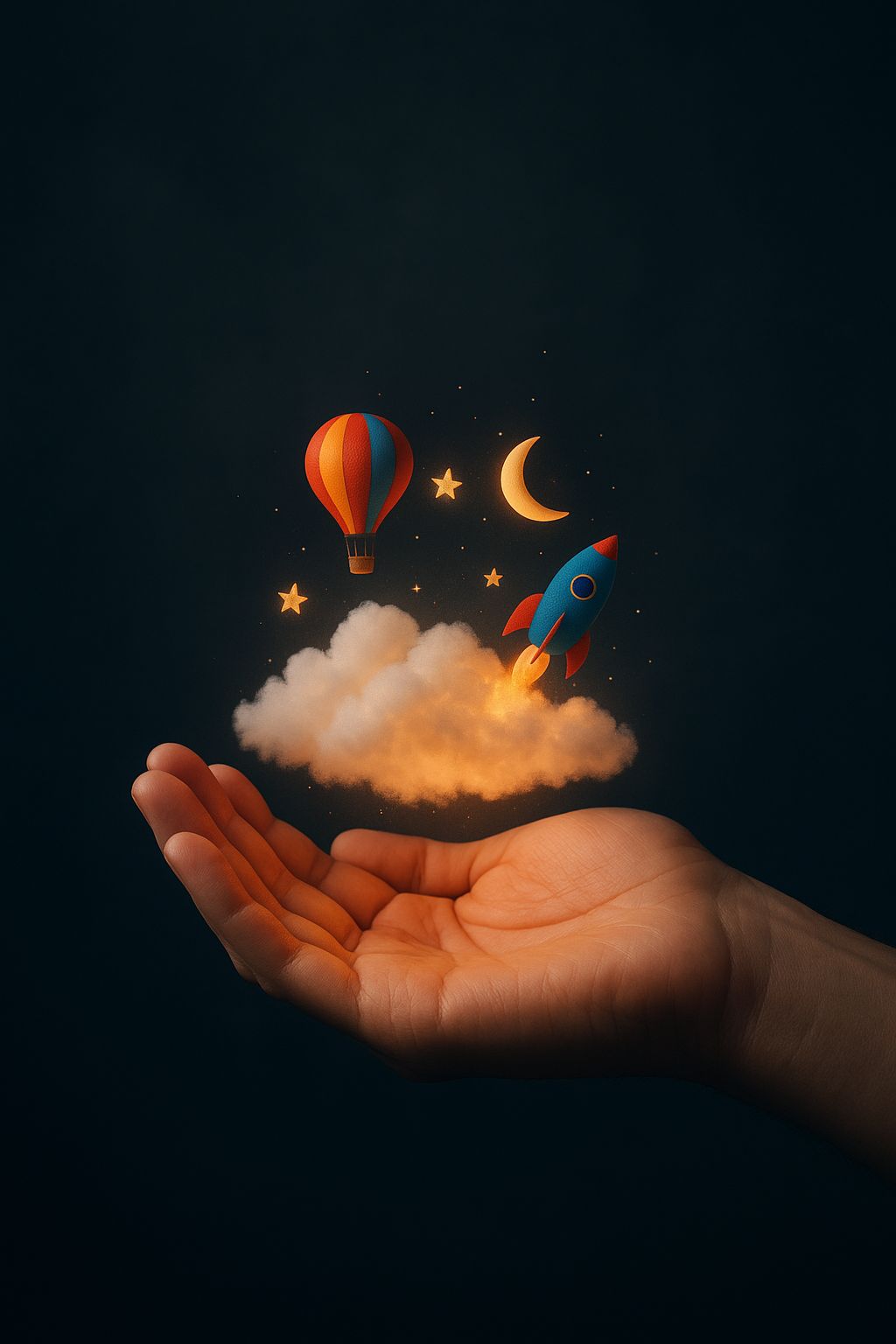
Our very own personal Imagination.
Imagination is not a luxury. It is a tool. A doorway. A force.
We tend to dismiss it because we can’t touch it, but so is Wi-Fi, an unseen force we depend on daily.
We tend to treat wonder as weakness. But what if imagination isn’t foolishness, but the key to freedom?
What if imagination is actually the bridge between what is and what could be?
What if reality bends not through force, but through perception?
Most people treat imagination as child’s play, a tool for fantasy, escape, or creativity at best. We dismiss the greatest creative force we have as fiction.
But imagination is not a luxury of artists; it is the engine of creation itself. It is the starting point of reality.
Every innovation, structure, every building, every invention and system we interact with today began as a simple, unseen thought in someone’s imagination.
The lightbulb wasn’t an accident, it was born first in the mind of Thomas Edison as a vision, a simple yet powerful “what if.”
The chair you’re sitting on was once nothing but a thought, a blend of comfort, support, and form imagined by someone. Planes, phones, art, languages, none of these existed until someone dared to imagine them into being
The physical world around us is a reflection of mental constructs that were once completely intangible. Before anything becomes a fact, it must start as fiction.
Imagination isn’t just a mental activity; it’s our built-in reality designer. It allows the human mind to preview what does not yet exist, to walk through futures before they unfold, and to prototype reality before it takes form.
That’s not a small feature; it’s magic hidden in plain sight.
Consider this: every time you imagine something vividly, a goal, a place, a solution, you are bending the boundaries of time and space, bringing the invisible into sharp focus.
No other species consciously rehearses tomorrow, paints futures in the mind, or builds realities from thought.
Imagination is the bridge between past, present, and future; it’s not just a creative tool but the very lens through which the human mind actively shapes experience.
Ask yourself, when was the last time you truly trusted your imagination, not to escape, but to create?
Those who regularly practice imagination, especially through intentional visualization, tend to cultivate stronger self-trust and emotional resilience. Why? Because the brain doesn’t distinguish between imagined experiences and real ones.
Neuroscience shows that visualization activates the same brain areas involved in actual performance, enhancing both awareness and inner belief.
Spiritually, imagination has long been honored across traditions, from Tibetan visualization practices to Sufi poetry to Christian prayers. To imagine is to remember your power to align with deeper inner truth. The more the mind is allowed to dream freely, the less it fears the unknown, because it has already seen itself survive it.
The present moment is always filtered through perception, and the future is shaped by internal narratives. Yet the mind, left unconscious, will exaggerate, distort, and fill in blanks with fear.
That’s when focus becomes a tool of power.
Focus is the fuel.
The more attention a thought receives, the more emotionally real it feels, until eventually moving from mind to matter. The conscious ability to focus and direct imagination consciously for your own benefit is a rare and precious luxury, one that begins with a decision to become aware, because most of the time, what you imagine does come true, whether it’s shaped by hope or fear.
As children, we lived in worlds that didn’t exist in the physical sense. We trusted them, played in them and felt them as real. Then we grew up and mistook seriousness for truth and playfulness for delusion.
But imagination was never a lie, it was the way through it.
This is the hidden power most adults forget: the ability to choose which thoughts to feed, which images to create, and ultimately which future to shape and bring forth, all starting from within.
Psychologically, this is self-agency.
Spiritually, this is co-creation.
Neurologically, this is neuroplasticity, the brain adapting to what it repeatedly envisions.
The reality you live tomorrow begins with the story you dare imagine today.
Whenever you find yourself lost in your mind, be lost in the right direction.
Let your thoughts be a place of possibility, not punishment.
No matter what you are going through, you are always allowed to go within and imagine a better outcome for what’s to come. This isn’t denial, it is design.
The mind, when guided by intention, becomes the blueprint for transformation.
The next time doubt creeps in or fear whispers that your thoughts don’t matter, remember that imagination is not the opposite of reality; it is the seed of it.
Choose your thoughts with awareness, with care.
What you choose to picture now, to feel now, to repeat now, becomes your life, now.

Stay Connected:
Follow us on Instagram: https://www.instagram.com/executivewomen_/
Connect on LinkedIn: https://www.linkedin.com/company/3654085/admin/dashboard/
Like us on Facebook: https://www.facebook.com/ExecutiveWomen/
Read more articles: https://executive-women.global/en/margueritta-rahal-weaving-spirituality-art-the-power-of-the-mind/embed/#?secret=icRr9iBsoV#?secret=n3avGYEWHP










 العربية
  English