


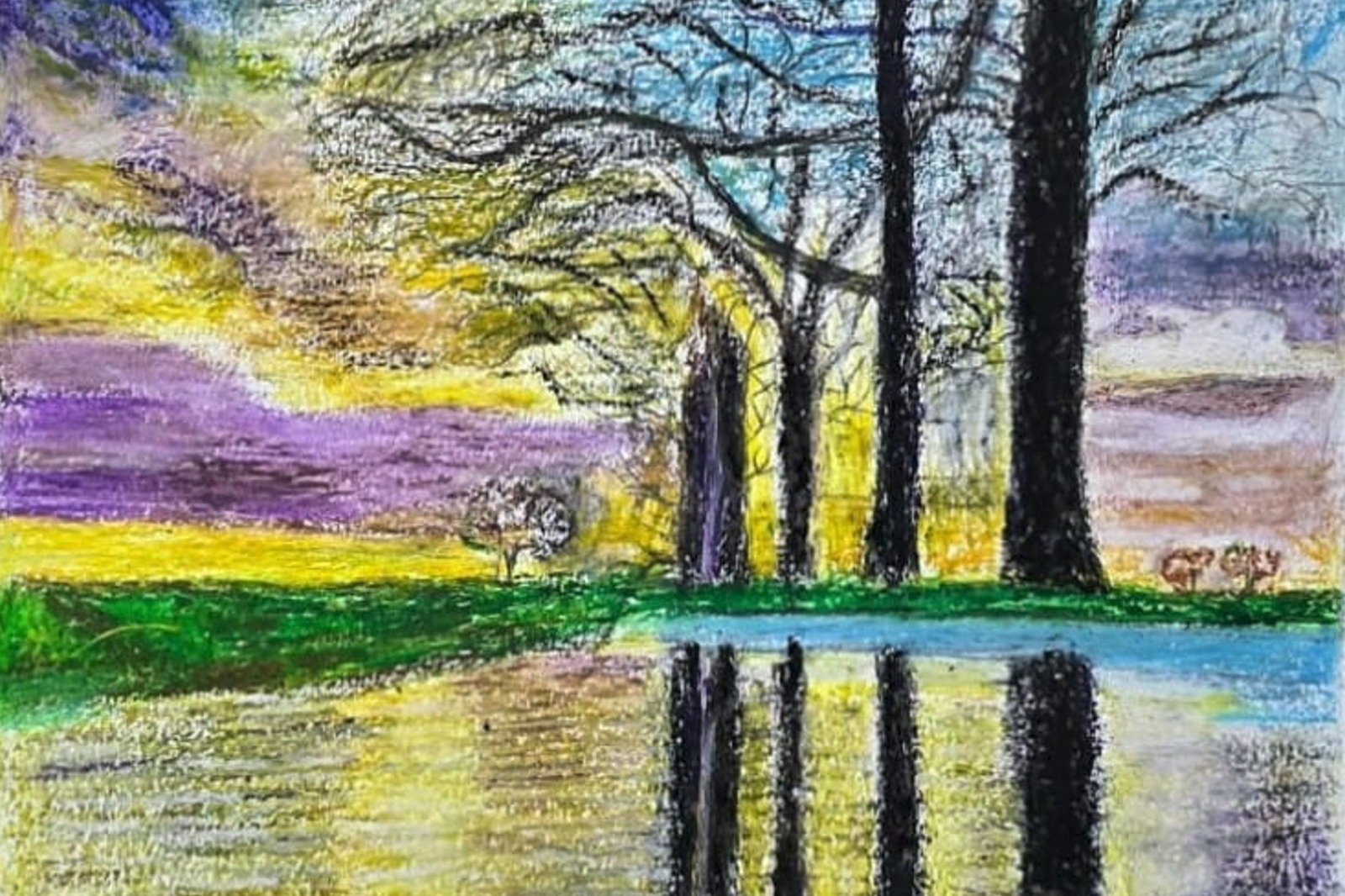
Where society sees potential as the privilege of youth, my 70-year-old mother stood as a gentle rebellion, though truthfully, she’s been challenging limits all her life. Wafaa Nazer grew up in the Qoubbé area, a warm, close-knit corner of Tripoli, where her father and four of his brothers, along with their sister, lived in three neighboring buildings. Family wasn’t just part of life; it was the structure it stood on. But in these traditional surroundings, the path laid out for girls was often shaped more by custom than by choice. At 13, while heading to school one morning, her cousin Samir, 16 years older, shared with his father that he wanted to marry her. His father, Bashir, the eldest of his siblings, conveyed the proposal to Wafaa’s father, Mustafa. The decision was made swiftly, as was customary. Wafaa got married that year and moved into an apartment just upstairs from her childhood home. Still, the schoolgirl in her hadn’t vanished. The morning after her wedding, she got dressed in her school uniform and walked to class. The principal met her with quiet finality: “You’re married now. You can’t attend school.” Just like that, the door was closed. But Wafaa was not one to surrender to closed doors. Ten years later, she had three children, and I was the fourth. We moved into a new apartment on Moutran Street. I was only 40 days old. My grandfather Mustafa moved too, into a home on Sakafe Street, just a few minutes away. These two homes, ours and our grandparents’, became the heart of our lives. It was within those familiar walls, between the ordinary rhythms of daily life, that my mother’s quiet, extraordinary journey began. That first year, she didn’t pass. But she didn’t give up. The following year, on the day the results were to be announced on national radio, she finally told my father. They used to announce results by candidate numbers, not names. Her number came up. She had passed. Abdel Halim’s joyful song played – “و حياة قلبي وأفراحه”-and we all sang along, proud and hopeful. My father, too, celebrated, believing this was the pinnacle of her ambition, that she had finally reached the end of that chapter. But what he saw as an ending was, in truth, only a doorway reopened. The dream hadn’t faded, it had simply been waiting, quietly, for its time to come again. Wafaa was only getting started. She enrolled at the Lebanese University to study Plastic Arts. She would leave us at our grandmother’s house and attend classes just across the neighborhood. Between the demands of motherhood and the weight of academia, she struggled to keep up with her attendance and ultimately failed the year. But undeterred, she enrolled again, quietly, privately, holding onto a dream too precious to abandon or explain Then one day, a man walked into the café where my father was sitting and congratulated him on Wafaa’s success. Dad was stunned. He hadn’t known that this man was mum’s professor at University. At home, he questioned her. “Why do you need a degree? You’re not looking for a job. I’m providing everything.” He simply didn’t understand why she would chase this dream. Eventually, she paused her studies once more. Years later, she quietly completed her BA and then a Master’s in Sociology, still without dad’s knowledge. She wanted to work. It took her some time, a few fights, but she eventually received his blessing. She went on to teach Arabic for 23 years. When she retired at 64, she began to study Arabic calligraphy. For nearly a decade, she practiced Arabic calligraphy with grace and determination. Then came 2019, a year of turmoil in Lebanon. The economy collapsed, and banks froze our accounts. My mother lost her life savings. Each unfamiliar word was a mountain to climb, but she climbed it. With a dictionary in one hand, and me, her daughter, on the other, she translated, interpreted, and persisted. Word by word, image by image, she made her way through. Technology was never her comfort zone, but her determination made it her companion. Her classmates didn’t always understand what drove her. To them, she may have seemed out of place, an unfamiliar presence in a space they thought was meant for youth alone. And while some professors did their best within the limits of long hours, tight schedules, and the harsh realities of underfunded public education, empathy wasn’t always present. A few even justified their detachment by saying the university system wasn’t designed with seniors in mind. A university is not merely made of software, whiteboards, and timetables. At its essence, it is a sanctuary of human potential. It is a place where intellect is sharpened, but more importantly, where the spirit is invited to unfold. Professors are not just transmitters of information; they are guides, mentors, keepers of the flame. They hold the sacred power not only to educate but to elevate. And in that sacred space, age should never be a dividing line. A student who enters a classroom at seventy carries a different kind of hope, one that has waited, perhaps decades, to be seen. One that may burn slower, but often brighter. What they need is not pity, nor indulgence, but presence, a little patience, and belief. They don’t ask for shortcuts. They ask for access. They don’t seek praise. They seek purpose. Education, in its highest form, is not about uniformity, it is about transformation. And no transformation, none, is possible without compassion, empathy, and the unshakable conviction that every soul, no matter when it arrives at the door, deserves to be welcomed in, guided forward, and lifted higher. Grit, Growth, and Lifelong Becoming Talent matters. But effort matters more. And sustained effort over time? That’s grit. Grit is not just working hard. It’s working hard at something meaningful—for a long time. It’s continuing when the mind tires, when the hands slow, and when uncertainty clouds the path. Grit is showing up

- بعد
- المديرين التنفيذيين

أغسطس 26, 2025

 العربية
  English