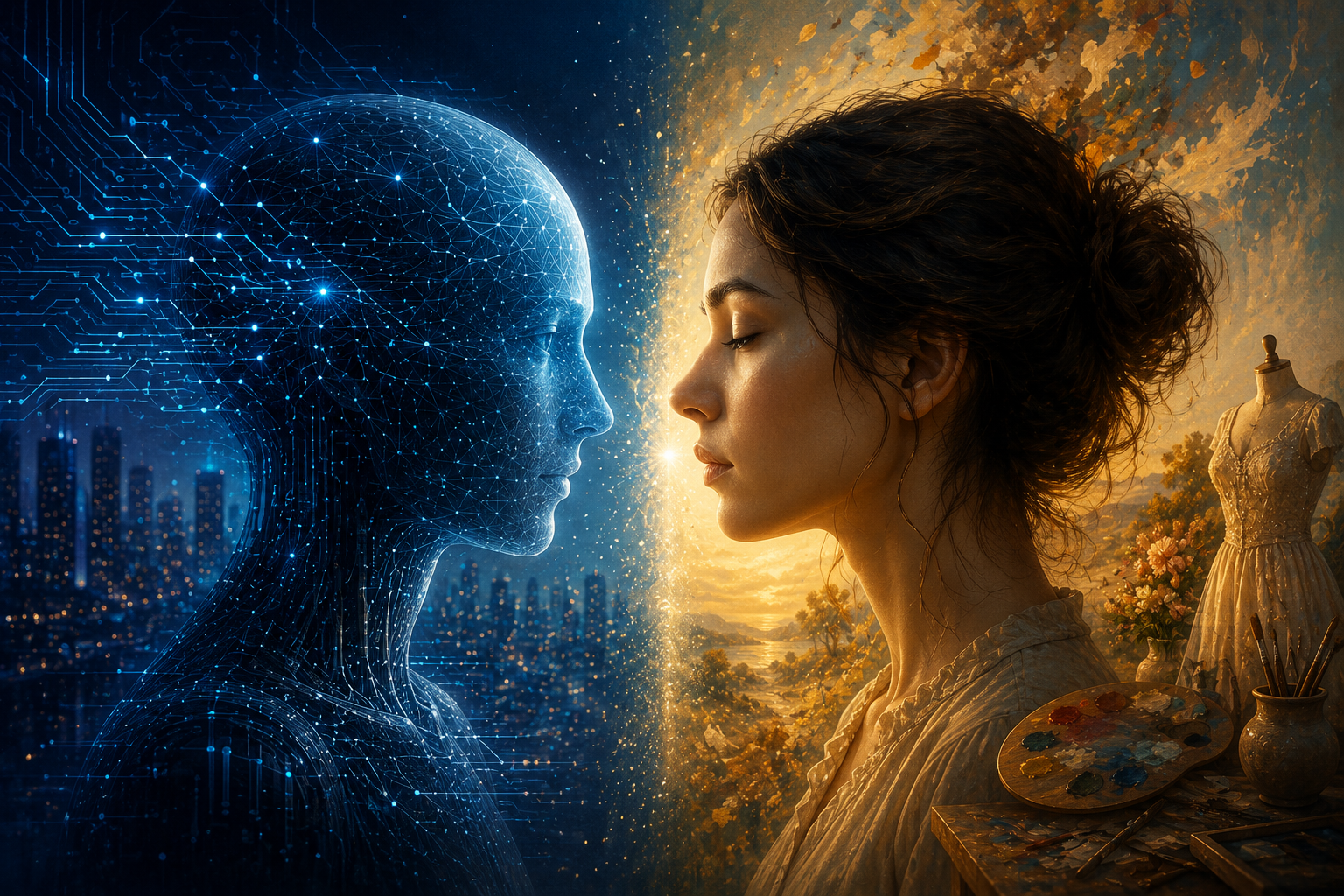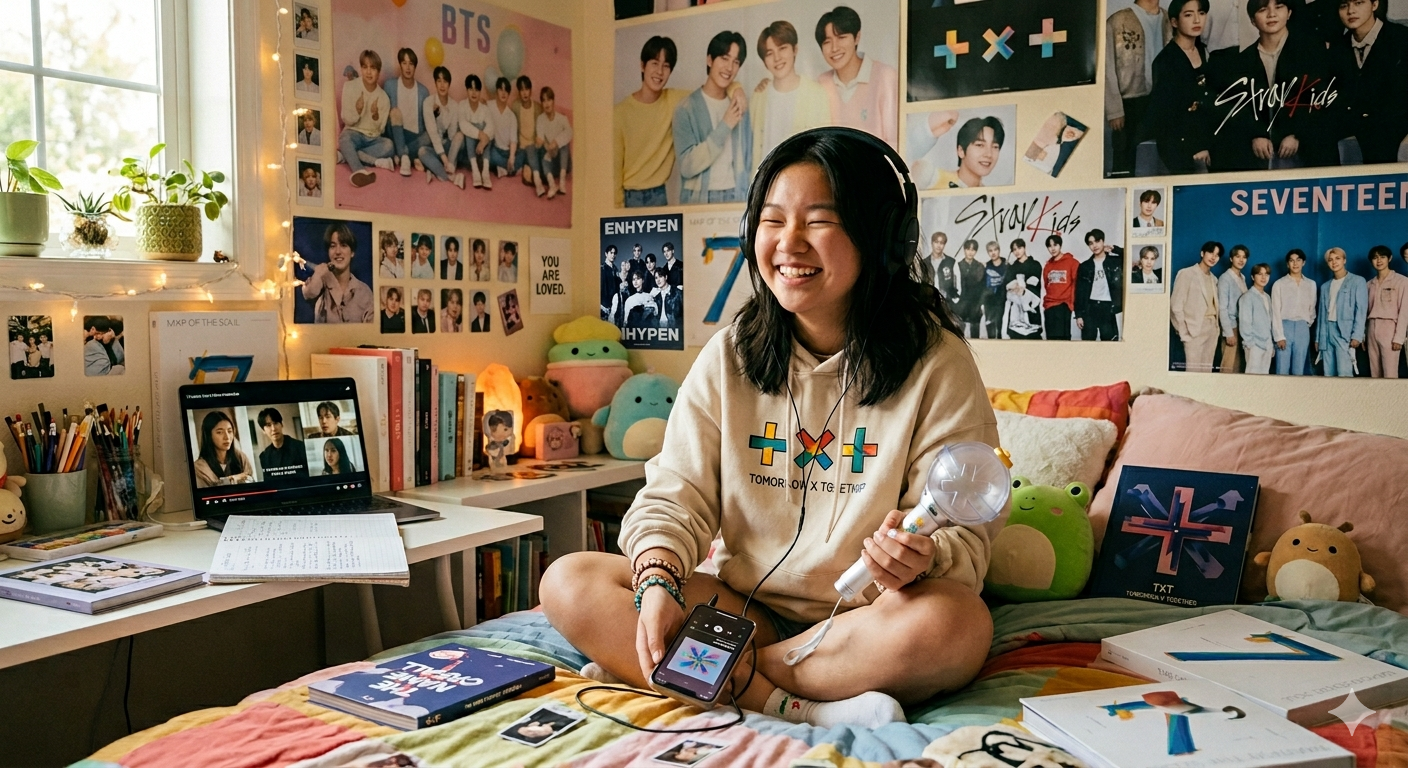
There’s a silent revolution happening. It takes place in bedrooms. It lives inside earbuds. Teenagers worldwide are leading it. Western pop music still churns out hits. These songs glorify toxic relationships. They promote emotional detachment. They celebrate material excess. But a growing number of Gen Z youth have found refuge in Asian music and culture. They turn to something entirely different. That includes K-pop, J-pop, and Thai pop. It also includes K-dramas, Thai dramas, and C-dramas.
The difference in these young people is visible. It is tangible. It is hopeful.
The Western Blueprint: Love as Pain, Success as Ego
For decades, American pop culture sold young people a specific blueprint. Western music did the same. This blueprint shaped how they view life. It also shaped how they view love.
A 2025 analysis from the University of New South Wales highlights this problem. The messaging has become pervasive.
Consider the lyrics dominating Western charts. Future raps, “She belongs to the streets.” This turns emotional avoidance into a viral slogan.
Olivia Rodrigo sings, “Maybe I’m too emotional / But your apathy’s like a wound in salt.” This teaches young listeners that love must hurt to be real.
The Weeknd frames dysfunction as passion. He sings, “Bring your love, baby, I could bring my shame.”
Country music offers no escape either. Morgan Wallen’s “Last Night” normalizes cycles of fighting and regret. Kelsea Ballerini’s “Miss Me More” reflects losing oneself entirely in romance.
Sarah Shields is a university student. She was quoted in recent research on music’s influence. She observes, “When artists glorify toxic behavior, social media magnifies it. This turns unhealthy relationship dynamics into trends.”
The consequences extend beyond relationships. A 2023 study examined sexual music lyrics. It found associations with risk behaviors among adolescents.
Other research links rap music exposure to earlier sexual initiation. This happens when exposure occurs in early adolescence.
Dr. Brian Primack is a media-and-health researcher. He argues that repeated exposure matters. Degrading or violent lyrics shape adolescents’ attitudes. They also shape their behaviors. This happens fundamentally over time.
In Peoria, Illinois, youth mentor Warith Muhammad works with teenagers. These teens are immersed in drill music. They also listen to aggressive rap.
“When you look at a lot of kids in the hood today, all they know is one type of music,” he explains. “That’s drill music. When you ask them to name one positive artist that doesn’t make music about killing, they can’t even give you a name.”
The result is devastating. Young people learn that love equals chaos, success means dominance, and vulnerability is weakness.
They absorb a worldview that treats relationships as transactional. Emotions become performative. Self-worth depends entirely on external validation.
The Eastern Alternative: Music That Heals
Half a world away, a different soundtrack plays.
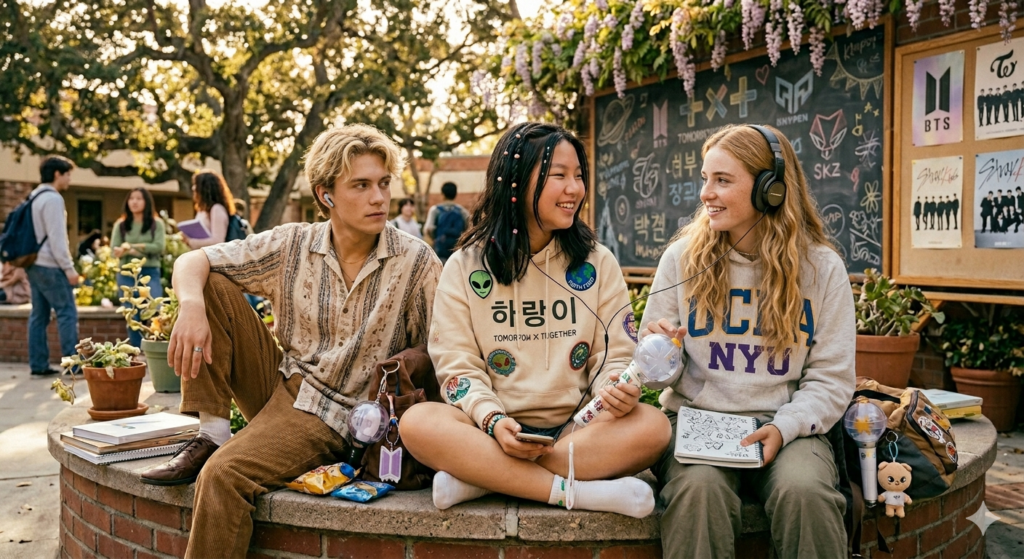
For example, K-pop groups like BTS have built massive global followings. Similarly, so have TXT, Stray Kids, and SEVENTEEN. Their success is not despite their positive messaging. In fact, it is because of it.
Moreover, their music doesn’t pretend life is perfect. Instead, it acknowledges struggle. But at the same time, it also offers hope.
Take TXT‘s “The Name Chapter: FREEFALL” era, which dropped in 2023. To illustrate, it literally invited fans to “leave their worries behind.” Specifically, the group created a special exhibition for this purpose.
The album tells a specific story. In particular, it follows the youth who choose to face reality. They do so with courage.
Four concepts captured this journey. First, “Reality” showed rainy streets. Second, “Melancholy” depicted dreams in unmagical places. Third, “Clarity” offered sunset hope. Finally, “Gravity” revealed scarred eyes and determined hearts.
As a result, the teaser promised something beautiful. “Sometimes magical moments can be found in the most unmagical places.”
Then, in October 2025, TXT partnered with UNICEF. Together, they launched the #TogetherForTomorrow campaign. In addition, they pledged $1.4 million to youth mental health initiatives worldwide.
The event took place at UNICEF House in New York. There, group leader Soobin delivered a moving message.
“Through our musical journey, we’ve learned that expressing our emotions is a sign of strength,” he said. “Now, in our campaign with UNICEF, we want to help create a safe and inclusive space for youth to freely express their emotions.”
This isn’t marketing. Instead, it is consistency. For years, TXT‘s music has openly chronicled growth. It has addressed worries. Above all, it has shared hope.
Similarly, member Hueningkai shares his honest thoughts. “I’m just hoping that our music can mentally care for them and be there for them,” he says. “I believe that many people in their 20s are going through mental pain or struggle these days.”
Furthermore, their song “Panic” speaks directly to struggling fans. Beomgyu co-wrote and performed it. The lyrics say, “Beneath the dark night / Let’s not stay here, but move on / In the days of bruises / Every step we take / You and I / Will find our way through.”
As a result, the impact on young listeners is profound. For instance, a 2023 study in Frontiers of Psychology made a key finding. Specifically, fans often form “para-social relationships” with their idols.
These are one-sided bonds. But surprisingly, they provide genuine comfort. Additionally, they also offer emotional support.
Whenever groups speak openly about mental health, young fans feel validated. Likewise, they also feel understood. The same happens when idols discuss self-worth or burnout. Consequently, this consistent message of hope becomes a lifeline..
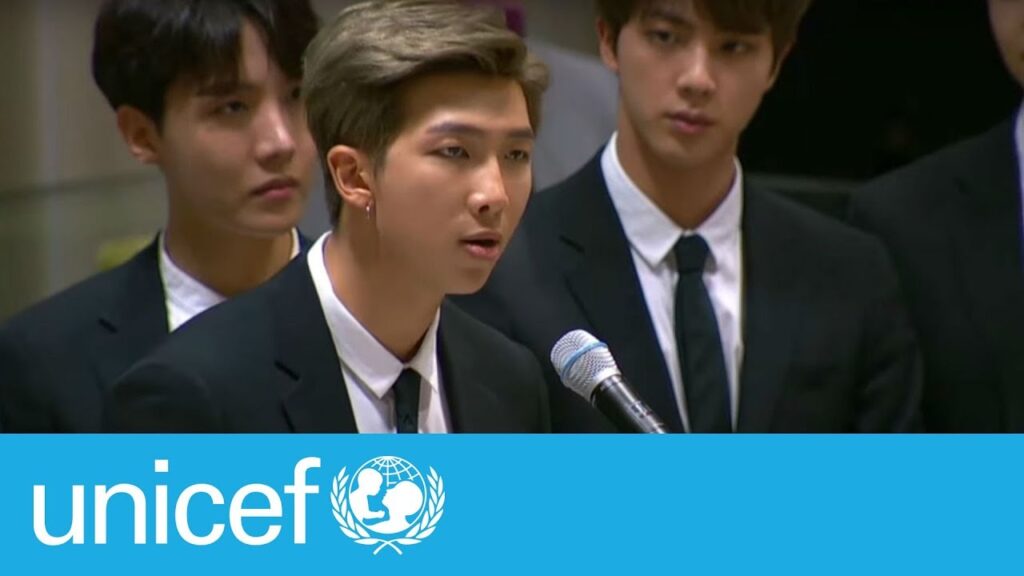
★ RM of BTS at the United Nations: A Voice for a Generation
No single moment captures K-pop’s healing power better than this. Kim Nam-joon is known as RM. He is the leader of BTS. He spoke not once, not twice, but four times at the United Nations.
His words never sounded like a polished speech. They sounded like a letter. They came from an older brother who finally learned to love himself.
At the 73rd UN General Assembly in 2018, RM said this: “No matter who you are, where you’re from, your skin color, your gender identity, just speak yourself. Find your name. Find your voice by speaking yourself.”
At the 75th UN General Assembly in 2020, he added: “I’m the person I love. I’m the person I want to be. I’m happy. So RM, from now on, let’s love ourselves. Let’s love ourselves today. Let’s love ourselves tomorrow. And forever.”
At the 76th UN General Assembly in 2021, he reminded the world: “The future is not dark. The future is something we can choose to build. Every step we take for ourselves, for our friends, for the planet — that is not a small step. That is the only step.”
And at the 79th UN General Assembly side event in 2024, he reflected on growth: “I used to think loving myself was selfish. But I learned that you cannot pour from an empty cup. When we care for our own minds, we become strong enough to care for others. That is not weakness. That is the beginning of everything.”
RM openly discusses therapy and self-doubt. He has become an unlikely role model for emotional honesty. His vulnerability teaches millions that strength isn’t about hiding pain. It is about naming it.
When a global icon stands at the world’s most powerful podium, something shifts. He admits he once hated himself. Then a teenager in a bedroom somewhere finally breathes. They think: Maybe I can try too.
The Drama Effect: Learning Love Through Storytelling
Beyond music, Asian dramas offer something rare. This includes K-dramas, Thai dramas, and C-dramas. They give young viewers emotional depth. They do so without exploitation.
Their romance is not toxic. Western teen dramas often rush through physical intimacy. They romanticize possessive behavior. They celebrate controlling partners.
Asian dramas take a different approach. They build tension slowly and prioritize emotional connection above physical gratification.
They show love as patience. Love is kind. Love is respectful.
Thai dramas (Lakorn) emphasize family loyalty. C-dramas focus on personal growth. Both highlight community responsibility.
Young viewers aren’t just entertained. They are taught to learn that relationships require effort, respect matters more than passion, and happiness doesn’t require self-sacrifice.
Gen Z navigates anxiety daily. They face academic pressure. They endure the loneliness of the digital age.
For them, these stories become something special. Psychologists call them “safe emotional mirrors.” They allow young people to feel deeply. This happens in a world that often demands numbness.
The Evidence: Hopeful, Not Depressed
The contrast is not just anecdotal. It is observable.
Teens immersed in K-pop show different attitudes. So do fans of Asian dramas. They view relationships, success, and self-worth differently.
They are more likely to discuss mental health openly, less likely to view toxicity as normal, and more hopeful about their futures.
The Philippines is one of the top five countries for K-pop streaming. Fans there don’t just listen. They live the experience.
They learn choreography, collect merchandise, join fandom groups, and celebrate idols’ birthdays as community events.
This isn’t passive consumption. It is active participation. It happens inside a culture of positivity.
Filipinos are known for emotional expressiveness. They love drama. They connect deeply with K-pop’s storytelling style. It mirrors their own psyche. It is passionate, hopeful, and resilient amid struggle.
Stray Kids fans describe the group’s impact uniquely. They call it “SKZ Therapy.” It goes beyond entertainment. It provides genuine psychological healing during tough times.
Within these fandom communities, something beautiful happens. Fans share stories. They offer encouragement. They create content that promotes positivity.
The fandom becomes a second family. This authentic engagement strengthens emotional resilience. It helps fans navigate daily life. They find newfound courage.
A UNICEF report released in mid-2025 shares important data. Gen Z is globally resilient. They are socially engaged. But many are overwhelmed.
Six in ten young people feel consumed by the constant news of global crises. Four in ten still feel stigma when discussing mental health.
But among those connected to supportive fan communities, the outlook is brighter. The same is true for those with positive artistic role models. Sixty percent of Gen Z remain optimistic. They want to actively shape a better future.
The Contrast: What Eastern Pop Culture Offers
The differences are stark.
Western pop promotes ego. It celebrates drama. It glorifies toxicity. Its messaging teaches young people that love is painful. Success is ruthless. Vulnerability is weakness.
Eastern pop culture consistently emphasizes different values. “Study hard. Respect your parents. Be a good person.” There is no toxic masculinity. No degrading behavior. Just pure motivation to be better.
Western pop frames relationships as transactional. They are temporary.
K-dramas and Thai dramas show love as patient. Commitment is meaningful. Family is central.
Western pop rarely addresses mental health. When it does, it often feels like performance.
K-pop idols speak openly about therapy. They share their self-doubt. They talk about their struggles. Then they partner with UNICEF. They fund mental health resources for youth worldwide.
Why This Matters Now
We live in times of war, uncertainty, and global crisis. Young people are glued to screens more than ever.
The content they consume isn’t just entertainment. It is education. It shapes how they see themselves, how they treat others, and what they believe is possible for their futures.
The teens who find K-pop aren’t escaping reality. They are finding a better one. They learn that success doesn’t require sacrificing kindness, love doesn’t have to hurt, and expressing emotions is a strength, not a weakness.
I have seen shy teenagers find purpose. I have seen struggling teenagers find hope. It happened because their favorite idol told them, “You matter.”
That’s not manipulation. That’s love.
The Western system might be broken. But the message these Eastern artists deliver? It heals.
As youth mentor Jaycee Bradley notes, “If they don’t have a positive influence, they’ll take whatever influence is popular. They tend to follow the trend.”
For millions of Gen Z youth worldwide, K-pop is not a trend. Neither are J-pop, Thai pop, or Asian dramas. They are lifelines. They are proof that another way is possible. That way leads not to numbness. It leads to hope.
★ A Letter to Parents
To the parent who walks past their child’s room and hears music in a foreign language. You see posters of boys with dyed hair. You worry this is just another obsession.
Stop. Take a breath. And listen.
You grew up with pop songs about heartbreak. You treated them as entertainment. Your child is growing up with pop songs about self-love. For them, this is survival.
When they put on those headphones, they are not running away. They are finally finding a voice. That voice tells them their problems are not their fault.
The Western culture you grew up with has become exponentially more cruel. It is more sexualized. It is more hopeless for today’s teenagers.
K-pop didn’t steal your child. It rescued them. It saved them from a music industry that teaches girls their worth is their body and boys that emotion is weakness.
Those “weird” dance practices and fan communities? That’s where your child learned something valuable. They learned that studying hard is cool, respecting elders is normal, and caring for your mental health is a sign of strength.
They are learning Korean words. That is true. But more importantly, they are learning a worldview. Loyalty matters. Kindness matters. Perseverance is the real flex.
Before you roll your eyes at the “obsession,” ask yourself a question. When was the last time a Western pop star told your daughter she was perfect exactly as she is? Without needing to change her body?
When did a rapper last tell your son that crying is brave?
K-pop idols do this weekly. That’s not a phase. That’s parenting. It’s parenting they never got from the radio.
The “para-social relationship” you might worry about? Psychologists say it often provides genuine emotional comfort. It helps lonely teens who feel unseen at school. It helps those who feel unseen at home.
Your child’s bias isn’t just a crush. They are a living, breathing example. Someone can work hard, stay humble, struggle, and still be loved. That is the lesson.
Finally, here is the hardest truth. If K-pop hadn’t found your child, TikTok’s algorithm might have fed them something far darker. Incel forums. Extreme diet culture. Nihilistic influencers who glorify giving up. Those are the real dangers.
So next time you hear that foreign music through the door, don’t knock to turn it down. Knock to ask which song is their favorite. Then listen.
Because in that song is the reason your child is still here. Still hoping. Still trying.
★ Ten Teens on How K-Pop Saved Their Mental Health
Maya, 16 – “I felt invisible at school. No one noticed me. Then I found ENHYPEN’s ‘Moonstruck.’ The song felt like a warm hug. Heeseung said in an interview that even small existences matter. I stopped trying to disappear. I started showing up instead.”
Jacob, 17 – “GOT7 saved me when I was at my lowest. I had no direction. Then I heard Jay B say that failure is just data for success. Jackson talked about his loneliness as a trainee. They didn’t pretend to be perfect. They were real. That reality kept me going.”
Mia, 16 – “Stray Kids saved me. I wasn’t eating. Bang Chan cried on a live stream and said to take care of my body. I ordered pizza that night. I’m still recovering, but I’m eating now.”
Jayden, 17 – “I punched walls when I got angry. My dad called me a monster. Then I saw RM say at the UN that he used to hate himself. I started therapy. I haven’t punched anything in over a year.”
Luna, 15 – “My counselor said I was attention-seeking. That night, I watched TXT’s Soobin cry on stage. My sadness was real. It was allowed. I’m still here because they made me feel seen.”
Ethan, 18 – “My house said ‘man up’ to tears. Then I saw ATEEZ’s Seonghwa cry on stage and talk about anxiety. He taught me that vulnerability is brave. Not weak.”
Sofia, 14 – “I was self-harming. Then I found BTS’s ‘Magic Shop.’ The line said, ‘I’ll heal you, you healed me.’ I wrote that on my arm instead of cutting. I’m 11 months clean.”
Marcus, 16 – “My father left. I thought I had to be cold. Then I watched SEVENTEEN’s Woozi produce songs about missing his mom. I cried for the first time in three years. It broke the fever.”
Olivia, 17 – “I had an eating disorder. What saved me was the fandom. Seventeen strangers sent me recovery resources. They didn’t know my face. They just knew I was hurting.”
Noah, 15 – “I had severe social anxiety. Learning K-pop choreography helped me move without judgment. Then I joined a Zoom dance group. Last month, I performed in front of 50 people. I shook. But I did it.”
Chloe, 16 – “My parents were divorcing. I blamed myself. I listened to BTS’s ‘Spring Day’ on repeat. It didn’t fix anything. But it made my grief feel like a language someone else spoke.”
Aiden, 17 – “I almost dropped out of school. Then I learned that RM failed multiple times before anyone believed in him. He wore his failures like medals. I went back. I graduate this spring.”
For millions of Gen Z youth worldwide, K-pop is not a trend. Neither are J-pop, Thai pop, or Asian dramas. They are lifelines. They are proof that another way is possible. That way leads not to numbness. It leads to hope.
Stay Connected:
Follow us on Instagram: https://www.instagram.com/executivewomen_/
Connect on LinkedIn: https://www.linkedin.com/company/executive-women/
Like us on Facebook: https://www.facebook.com/ExecutiveWomen/
Read more articles: https://executive-women.global/en/the-gulfs-growth-engine-how-women-in-finance-will-power-the-next-economic-wave/